
How to Create Mockups That Impress Your Clients
Learn how to create mockups that win projects. This guide covers planning, tool selection, and presentation tips for designers.
November 2, 2025•13 min read
Discover what is royalty free images and how this license works, how it differs from others, and how to choose visuals for your projects.
Instastock Team
October 24, 2025 • 11 min read
So, you've heard the term "royalty-free" thrown around, but what does it actually mean for you and your projects? Let's break it down.
At its core, a royalty-free image licence is beautifully simple. You pay a single, one-off fee to use a high-quality visual. That's it. Once you've paid, you can use that image again and again across different projects without ever having to pay another penny in royalties.
But here's a crucial point to remember: royalty-free doesn't mean cost-free. There's still that initial payment for the licence.
Imagine buying a great album on vinyl. You pay for the record once. After that, you can play it at home, in your car, or at a friend's house as many times as you like. You don't owe the artist a little bit of money every time you drop the needle. That's the royalty-free model in a nutshell.
This one-time purchase gives you what's called a perpetual licence, meaning your right to use the image never expires. You can pop it on your website today, use it in a social media campaign next month, and feature it on a printed brochure next year—all covered by that original licence.
The real magic of royalty-free is its flexibility. That single fee gives you broad permission to use the image across all sorts of different media, which is a massive win for marketers, bloggers, and just about any content creator out there. It’s this kind of easy access that’s helping to meet the ever-growing demand for fresh visuals in digital marketing.
In fact, the UK stock images and videos market is booming, expected to grow by USD 128.3 million between 2023 and 2028. This just goes to show how essential high-quality, accessible visuals have become for modern businesses.
This is a world away from other licensing models, where you might get charged based on how many people see the image, how long you use it for, or where you display it. The royalty-free approach makes budgeting and legal stuff much more straightforward, putting professional-grade images within everyone's reach.
To get a better picture of how this all fits together, it’s worth taking a step back to understand what is stock photography and the role it plays in the creative world.
To make it even clearer, here’s a quick table breaking down what royalty-free really means for you when you're choosing an image.
| Feature | What It Means For You |
|---|---|
| One-Time Payment | You pay once for the right to use the image, with no recurring fees. |
| Multiple Uses | You can use the same image on your website, social media, print ads, and more. |
| Perpetual Rights | Your licence to use the image doesn't have an expiry date. |
| Non-Exclusive | Keep in mind, you're not the only one; other people can also license and use it. |
Ultimately, this model gives you incredible freedom and value, letting you focus on creating brilliant content without getting bogged down in complicated licensing agreements.
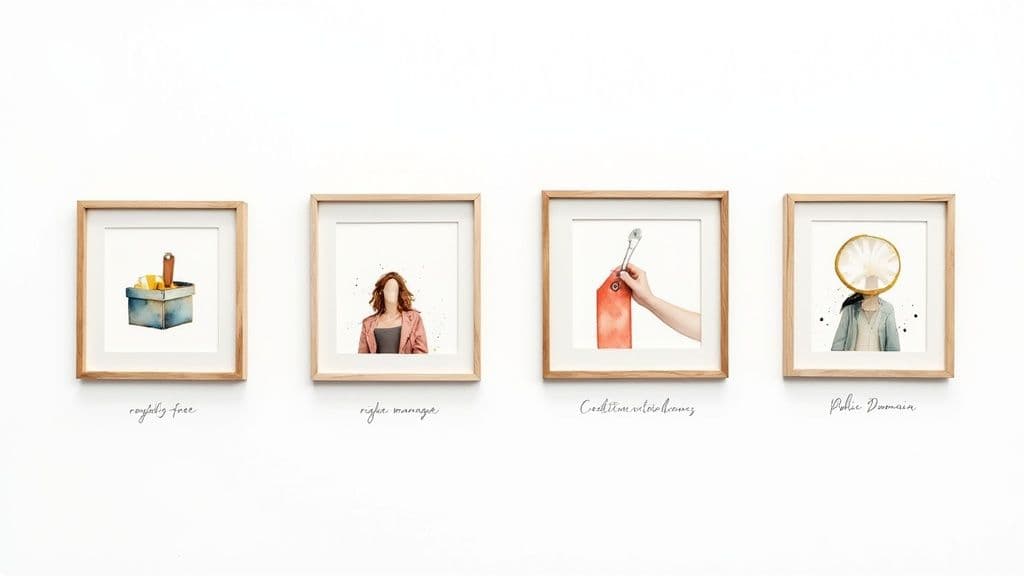
To really get a feel for why royalty-free is so popular, it helps to see how it stacks up against the other options out there. Not all image licences are the same, and picking the wrong one can land you in hot water with surprise costs or legal headaches.
Think of royalty-free as your go-to, flexible friend for most creative projects. It’s built for simplicity. But sometimes, other licences are better suited for very specific jobs. Let’s break them down.
A Rights-Managed (RM) licence is like renting a bespoke suit for a single, high-profile event. You pay based on exactly how, where, and for how long you'll use the image. It’s all about control and exclusivity.
This is the kind of licence major brands use for big advertising campaigns when they need to guarantee no competitor can use the same photo. The price tag is much higher, and the rules are strict. Want to reuse that image in a different campaign? You’ll need to open your wallet and negotiate a brand-new licence.
This is a world away from the “pay once, use it over and over” simplicity of royalty-free. For everyday content like blog posts or social media, RM just isn't practical.
Creative Commons (CC) is a wonderful, community-spirited system. It's a non-profit that offers free copyright licences for creators who want to share their work with the world, but with a few strings attached.
There are different types of CC licences, but most demand attribution—meaning you have to credit the person who created it. Others might say "no commercial use" or prevent you from altering the image. It’s a fantastic resource, but you absolutely have to read the fine print on each image.
Last but not least, you have Public Domain images. These are works where the copyright has expired, been forfeited, or was never applicable in the first place. You can use them for anything you want—commercially or personally—with no credit needed and zero restrictions.
Sounds perfect, right? The catch is that finding high-quality, relevant images in the public domain can be like searching for a needle in a haystack. The selection is tiny compared to the vast libraries offered by stock photo sites.
To give you a clearer picture, here’s a quick-glance table breaking down the key differences.
| License Type | Cost Structure | Usage Rights | Best For |
|---|---|---|---|
| Royalty-Free | One-time fee, sometimes subscription-based. | Perpetual, multi-use, non-exclusive rights. | Everyday business use, blogs, social media, small-scale marketing. |
| Rights-Managed | Pay-per-use; price varies by exclusivity, duration, and placement. | Highly specific, time-limited, and often exclusive. | High-budget advertising campaigns, billboards, and magazine covers. |
| Creative Commons | Generally free, but with conditions. | Varies by licence; often requires attribution, non-commercial use. | Non-profits, bloggers, artists, and projects on a tight budget. |
This table shows why royalty-free hits that sweet spot of affordability and flexibility for most people.
It’s no surprise that royalty-free images are the engine of the digital content world here in the UK. The industry is huge—it's estimated that in 2025, the UK's photographic activities sector will bring in £1.9 billion in revenue. Just look at a major player like Shutterstock; its library exploded from 30,000 photos at its launch in 2003 to over 406 million images by 2022. That growth really shows you the sheer scale of the royalty-free market. You can dig into more Shutterstock statistics and trends to get the full picture.
So, why do so many creators and businesses lean on royalty-free images? Beyond the textbook definition, it really boils down to three massive perks: cost, simplicity, and versatility. Let's break down what that actually means for your projects.
First up, predictable budgeting. With a royalty-free licence, you pay a one-time fee, and that’s it. No surprise invoices or extra charges popping up later because your campaign got a million views. This makes planning your project finances a breeze.
This kind of financial clarity is a big deal, and it's why the global stock photography market, which is dominated by the royalty-free model, is projected to reach about USD 11.25 billion by 2032. Europe plays a huge part in that growth, and you can dig into more stats on the global stock photography market's expansion.
Another huge advantage is how straightforward the whole process is. The licence agreement is simple and easy to grasp, meaning you don't need to get tangled up in complex legal negotiations. You can spend less time stressing about compliance and more time actually creating.
Then there’s the versatility, which is where royalty-free really shines for most day-to-day needs. One licence can power an entire campaign.
Think about it: you find the perfect image, license it once, and then you're free to use it as your website banner, in a series of Instagram ads, on a printed flyer, and even in a client presentation. One payment, endless possibilities.
This multi-use freedom offers an incredible return on your investment. Let's look at a couple of real-world examples:
This simple yet powerful model empowers businesses of all sizes to create professional, visually consistent content without a massive budget. It truly puts high-quality visuals within everyone's reach.
It’s easy to think that using royalty-free images is a straightforward affair, but a few persistent myths can land you in some serious legal and financial hot water. Let's clear the air and make sure you're using visuals for your brand safely.
The biggest tripwire is thinking royalty-free means completely free or copyright-free. It absolutely doesn't. While you’re off the hook for ongoing royalty payments, you almost always need to buy a licence upfront. Simply grabbing an image without one is a fast track to copyright infringement.
Another common slip-up is assuming you "own" the image once you've paid for the licence. Think of it more like a long-term rental. The licence is usually non-exclusive, meaning you're one of potentially thousands of people using that exact same photo.
Beyond those big misunderstandings, the devil is truly in the details of the licence agreement. Skimming over the fine print is a gamble, and violating the terms can have some pretty nasty consequences.
Here are a few standard restrictions you’ll almost always find:
These rules aren't just there for show; they protect the photographer's copyright and the dignity of any models involved. Ignoring them is a huge risk that can lead to expensive legal battles and tarnish your brand's reputation.
Getting your head around the legal side of things is a must for any creator. These kinds of myths aren't just limited to images, either. For example, it’s just as important to understand the legal implications of using copyrighted content when working on video projects.
By busting these myths, you can start using royalty-free images with real confidence. For a much deeper dive into staying on the right side of the law, check out our detailed guide on how to avoid copyright infringement.
Alright, you've got the basics down – what royalty-free means, the legal tightropes to walk, and all the benefits. So, where do you actually find these magical images without accidentally stepping on a legal landmine?
Let's talk about sourcing your visuals safely. It’s actually pretty simple once you know where to look and what to look out for.
Your safest bet will always be the big, established stock photography websites. I'm talking about the household names: Getty Images, Adobe Stock, and Shutterstock. There's a reason they're leaders in the game. They have iron-clad vetting processes, which means you can be confident that every image on their platform is licensed correctly and ready for commercial use.
Now, what about the free sites like Unsplash or Pexels? They're incredibly popular, and you can find some real gems there. But a little bit of caution goes a long way. There have been cases where people have uploaded photos they didn't actually own, which puts anyone who downloads them in a sticky situation.
And whatever you do, please don't just grab an image from a Google search. That's a direct route to trouble. Most of those images are copyrighted, and using them is a gamble. Specialist intellectual property firms make a living tracking down this kind of unlicensed use, and a legal notice from them can be a very expensive surprise.
The golden rule is this: only get your images from sources that clearly and explicitly guarantee their licensing. If a site looks a bit dodgy or doesn't have a crystal-clear terms and conditions page, just walk away. It’s not worth the risk to your brand.
Before you hit that download button, just run through this quick mental checklist. It'll save you a world of headaches later on.
Following these simple habits means you can build up a fantastic library of visuals that are not only stunning but also 100% legally sound. A little bit of diligence upfront gives you total peace of mind, letting you get back to what you do best: creating amazing content.

The world of stock imagery is definitely changing, and artificial intelligence is at the very heart of this shift. AI image generators have emerged as a powerful new way to create visuals, tackling one of the biggest frustrations with the traditional royalty-free model: everyone using the same photos.
We’ve all been there. You find a fantastic royalty-free picture, only to see it pop up on a competitor's website a week later. This can really water down a brand's unique identity and make it tough to stand out. AI completely turns that problem on its head.
Instead of digging through endless libraries for a photo that’s almost right, you can now create a totally unique visual from scratch, exactly how you imagined it. This is a massive win for anyone trying to build a distinct brand style.
The best part is that these incredible tools are becoming easier for everyone to use. High-quality, custom-made images are no longer just for big companies with massive photography budgets.
This change means anyone can tell their story with visuals that are precise and personal. Fancy an image of a red double-decker bus on Mars, but in a pop-art style? An AI can whip that up in moments, giving you an asset that is truly yours and yours alone.
As this technology gets even better, it’s worth checking out the best AI tools for image creation to see what's possible. The power to produce bespoke visuals quickly and cheaply is completely redefining digital content. If you’re curious to try it yourself, our guide on how to generate images with AI is a great place to start. This new frontier offers unlimited creative freedom, taking us far beyond the limitations of old-school stock photos.
Let's tackle some of the most common questions that pop up around royalty-free images. Getting these details straight will help you use visuals with total confidence.
This is a big one, and the short answer is almost always no. Standard royalty-free licences are very clear about not allowing their images to be used in logos, trademarks, or any other kind of brand identifier.
Think about it: a logo needs to be unique to you and legally protectable. Since anyone can licence the same royalty-free image, it can't be exclusive. Always give the specific licence agreement a once-over to be absolutely sure.
For the most part, if you're buying from big players like Shutterstock or Adobe Stock, you don't need to add a credit. The licence fee covers that.
However, this isn't a universal rule. Some platforms, especially free ones, might make attribution a part of the deal. The golden rule is to always check the terms for each image you download.
A key takeaway here is that licence terms can vary wildly from one source to another. Never assume the rules are the same everywhere; a quick check can save you a world of legal headaches down the road.
Nope. You can definitely get creative and tweak a royalty-free image to match your brand's style, but you don't gain ownership of the original work. The copyright stays firmly with the person who created it.
You own your specific edits, but not the underlying photo. This means you can't turn around and sell your edited version as a new stock photo.
Here's one of the best things about the royalty-free model: the licences are usually perpetual. That's just a fancy way of saying they never expire.
Once you’ve paid for the licence, you can use that image forever according to the terms. No time limits, no renewal fees, no fuss.
Tired of sifting through stock photo libraries and trying to make someone else's image fit your vision? With Instastock, you can create completely original, high-quality images with AI that you actually own. No strings attached, no recurring fees.
Why not give it a go? Create your first five images for free and see the difference for yourself.
Learn how to create mockups that win projects. This guide covers planning, tool selection, and presentation tips for designers.

What is omnichannel marketing? Learn how to build a seamless customer experience that drives loyalty and growth for your UK business with this practical guide.
Your complete guide to social media image dimensions. Get the latest sizes and best practices for Instagram, Facebook, X, and LinkedIn to optimize your content.